

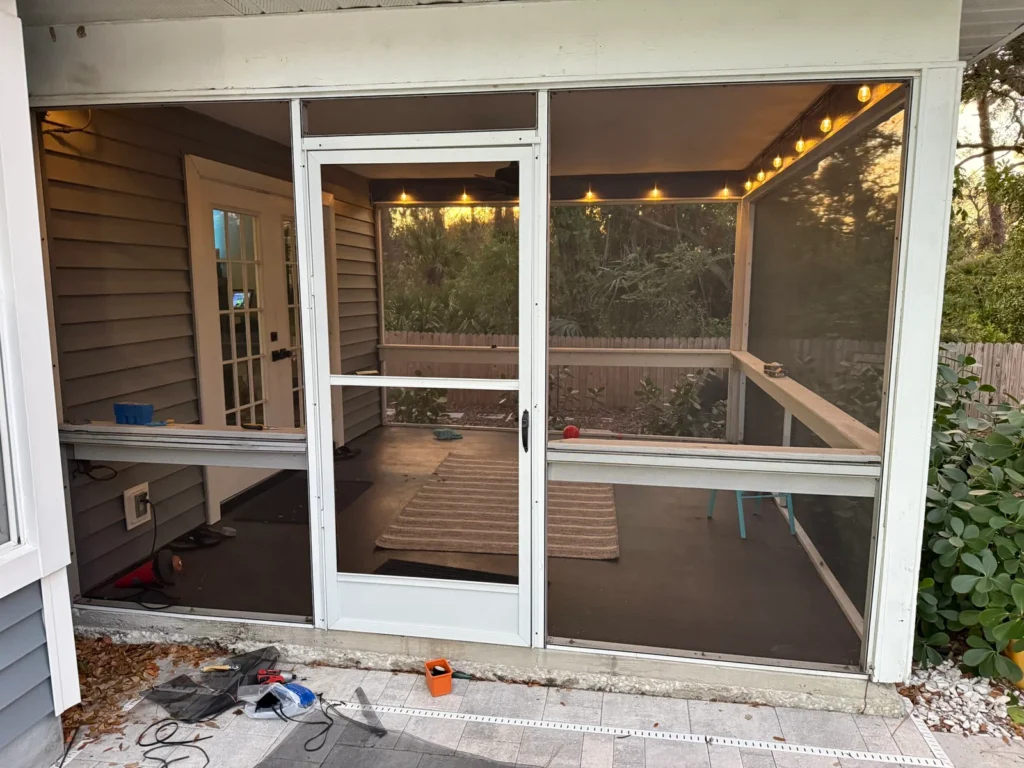
Plenty of Florida homes come with a covered lanai that was never actually screened a builder-installed roof over a slab, sitting open on all sides since the day the house was finished. It’s one of the most common questions homeowners ask before starting a project: can that existing structure just be screened in, or does something bigger need to happen first?
The short answer is that it depends on a few specific things about how the lanai was originally built. Here’s what actually determines the answer.
Table of Contents
Perimeter Support Is the First Thing That Matters
Screening needs something solid to attach to along the edges — posts, beams, or a low wall the framing and mesh panels can be secured into. Many covered lanais already have some form of support posts holding up the roofline, which is a good starting point. If the structure is genuinely open with no vertical support at the perimeter, that framing typically needs to be added before any screening can go in.
The Roof Itself Needs to Be Sound
An existing lanai roof — whether it’s a standard shingled overhang, a flat concrete slab extension, or an aluminum cover — generally needs to be structurally solid before screening is added. Cracking, sagging, or visible wear in the roof structure should be addressed on its own merits, separate from the screening decision, since attaching new framing to a compromised roof isn’t a lasting fix.
Roofline Shape Affects How Straightforward the Job Is
Lanai roofs come in a range of shapes — mansard, dome, gable, hip, shed, and flat are all common configurations. Roughly rectangular lines with a single, continuous roof plane tend to be the most straightforward to screen, since mesh panels fit in predictable sections. More complex rooflines, multiple angles, or unusually low clearances can still be screened, but often involve more custom fitting than a standard shape would.
Permits Still Apply
Even when the existing roof is fully screen-ready, adding an enclosure typically still requires a permit, since it changes how the structure is classified and can involve wind-load review depending on your county. This applies whether the roof is brand new or has been standing uncovered for years — the permitting step doesn’t disappear just because the roof already exists.
HOA Approval Is a Separate Conversation
If your lanai sits in a deed-restricted community, screening it in often requires HOA architectural approval on top of the standard building permit — and that process runs on its own timeline, separate from the county’s review. This comes up often enough with existing, previously unscreened lanais that it’s worth starting the HOA conversation early, rather than assuming an existing structure makes approval automatic.
When Screening the Existing Roof Makes Sense
If the roof is structurally solid, there’s usable perimeter support already in place, and the shape allows for standard panel sizing, screening the existing lanai is usually the more practical route. You keep the roof you already have, along with whatever architectural details already match your home, and simply add the framing and mesh needed to close it in.
When It Makes More Sense to Rebuild
A few situations tend to point toward a fuller rebuild rather than a straightforward retrofit:
- The roof shows real structural wear that needs attention regardless of screening plans
- There’s little to no usable perimeter support, meaning most of the framing has to be added anyway
- The existing shape doesn’t lend itself to standard mesh panel sizing, making a from-scratch build simpler than forcing a retrofit
- You want a different roof style entirely — insulated sandwich panels, for example, aren’t always a simple addition to an existing open-air roof structure
Front Lanai vs. Back Lanai: Does It Change Anything?
Not structurally, but it’s worth mentioning — front lanais are often smaller and more visible from the street, which can bring the HOA and curb-appeal considerations mentioned above into sharper focus. Back lanais tend to have more flexibility in roof shape and mesh choice, since privacy and personal use usually matter more than street-facing appearance.
The Only Reliable Way to Know for Sure
A lanai roof that looks straightforward from underneath can still have perimeter or structural issues that aren’t obvious without a proper look, and a roof that seems like it needs a full rebuild sometimes turns out to be a simpler retrofit than expected. An on-site assessment is really the only way to know which category your specific lanai falls into.
Find Out What Your Lanai Actually Needs
Rather than guessing, it helps to have someone experienced with lanai construction take a real look at your existing structure. Eclipse Service Hub can assess whether your covered lanai is screen-ready as-is, or whether a rebuild makes more sense, across the Tampa Bay, Sarasota/Bradenton, and Southwest Florida areas we serve.
Schedule a free on-site assessment or explore our full lanai screen enclosure services to see what’s possible for your space.
Frequently Asked Questions
Can an existing covered lanai be screened in?
Yes, in most cases. Eclipse Service Hub can screen an existing structure or build a new enclosure. Whether the existing lanai can be screened as-is comes down to its perimeter support, the condition of the roof, and the shape of the roofline.
What if my lanai has no posts or walls around the edges?
Screening needs a solid structure to attach to. If the lanai is fully open with no vertical support at the perimeter, that framing generally has to be added first. Depending on how much needs to be built, a fuller rebuild can sometimes be simpler than a retrofit.
Do I need a permit to screen in an existing lanai?
Often yes, depending on the type of structure and your county. An enclosure changes how the structure is classified and can involve wind-load review, even when the roof is already in place. Eclipse Service Hub handles the engineering and permitting.
Do I need HOA approval?
If your home is in a deed-restricted community, often yes. HOA architectural approval is separate from the building permit and runs on its own timeline, so it’s best to start that conversation early. Check your community’s requirements before you finalize a design.
How long does lanai screen installation take?
Typically 1-2 days once permits are approved and materials are ready. The permit and approval stage usually takes longer than the build itself.
Can I add a ceiling fan or lights to my screened lanai?
Yes. Insulated roof panels support fans and light fixtures, and a licensed electrician is required for the wiring. If your existing roof is an open-air structure, whether it can carry fans or lights is something to confirm during the on-site assessment.
Can I switch to insulated roof panels on my existing lanai?
Not always as a simple add-on. Insulated sandwich panels can be a better fit for a new build or rebuild than for an existing open-air roof structure, so it’s worth raising when you schedule your assessment.