
Table of Contents
Most advice on making a screen enclosure last begins after the crew packs up: rinse the mesh, check the screws, clear the gutters. That advice matters, and our screen enclosure care guide walks through it step by step. But in Florida, much of an enclosure’s lifespan is settled before the first post goes in. Who builds it, what holds it together, how the roof handles wind and water, and which mesh goes where all shape how well it stands up to years of sun, humidity and storm seasons.
Whether you are comparing pool enclosure contractors in Florida for a new pool cage or planning an aluminum screen room installation in Florida, these five tips focus on the decisions that are hardest to change later, plus the habits that protect everything afterward.
1. Hire a Contractor Who Engineers, Permits and Builds In-House
A screen enclosure is a structure, not just a set of screens. In Florida it needs to be engineered and built to code, and pool cages and screen rooms require permits. That paperwork is more than a formality. It is the record that your frame was designed for the wind and weather it will actually face.
Before you sign with any of the pool enclosure contractors in Florida on your shortlist, ask:
- Are you licensed and insured in Florida? Get the license number. You can verify any Florida contractor license through the state’s Department of Business and Professional Regulation (DBPR).
- Who handles engineering and permits? It should be the contractor, not you.
- Will your own crew build it, or is the work subcontracted?
- Who do I call if something needs adjusting after the job?
An in-house crew matters for longevity because the team that plans the layout is the team that installs it, so details like door placement, roof tie-ins and drainage carry through from the estimate to the finished build. Eclipse Service Hub holds State Contractor’s License #SCC131154203, handles all engineering and permitting, and builds with its own team, with no subcontractors.
2. Look Past the Frame to the Fasteners and Connections
Aluminum is the right framing material for Florida. It does not rust, rot or attract termites, which is why it is the standard for pool cages and screen rooms (more on that in why aluminum is the best choice for Florida screen enclosures). But a frame is only as durable as the hardware holding it together. Salt air, pool splash and constant humidity all work on screws, anchors and brackets, so the connections deserve as much attention as the aluminum itself.
Questions to raise during your estimate:
- What fasteners will you use? Eclipse pool cages are built with corrosion-resistant stainless steel fasteners, and Eclipse structures use hurricane-rated aluminum and fasteners built to Florida code.
- How does the enclosure connect to my home and slab? An attached pool cage ties into the home’s structure, while a detached cage stands on its own independent support. A screen room can be built on your existing slab or on an extended one.
- If I am expanding or rescreening an older enclosure, should the hardware be replaced too? One Eclipse customer had every existing fastener on their lanai replaced as part of an expansion. That is the sensible time to do it, since the structure is already being worked on.
The same thinking applies, at a larger scale, to aluminum screen room installation in Florida. A screen room is fully framed with structural aluminum beams, typically carries an insulated roof, and comes with matching gutters and downspouts. Every one of those connections has to be right for the room to stay tight and dry over time.
3. Match the Roof to Your Exposure and Plan Where the Water Goes
Roof shape affects how an enclosure handles wind. Roof material affects how it handles sun and rain. Both play into how long it lasts.
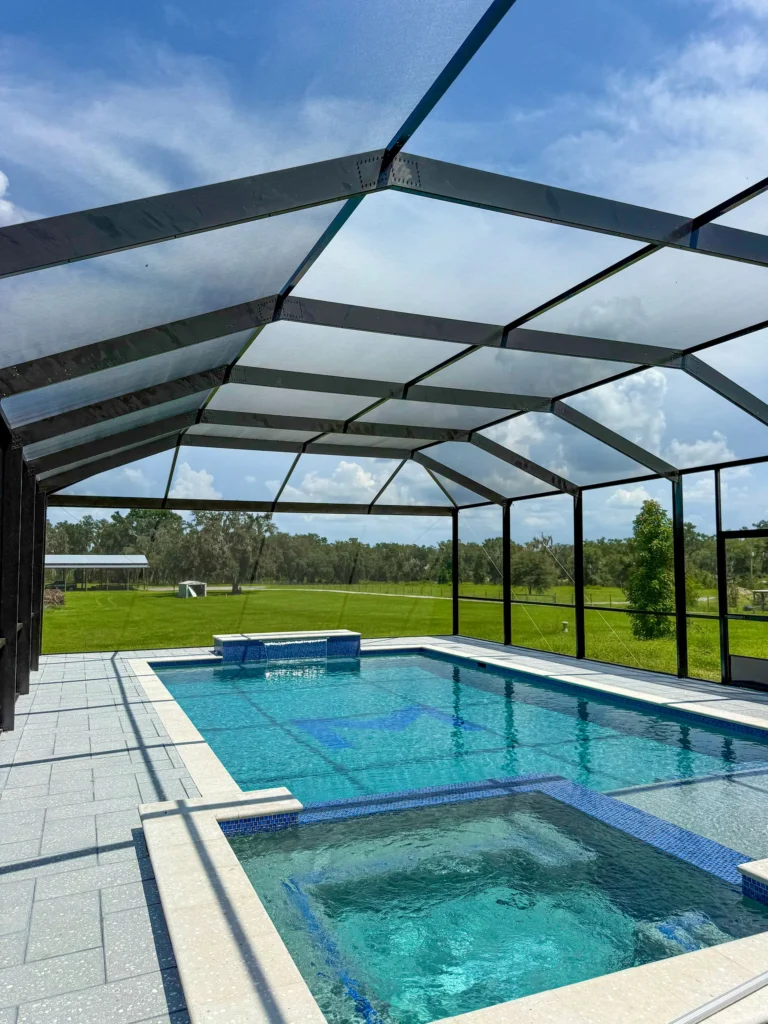
Shape. Eclipse builds mansard, dome, gable, hip, shed and flat roofs. Hip roofs, sloped on all four sides, are the strongest option for wind resistance and suit storm-prone or open lots. Dome roofs are designed to improve wind flow and work well on larger enclosures. Flat roofs need a slight pitch so water runs off. Our mansard vs. dome vs. gable comparison covers the tradeoffs in more detail.
Material. Insulated sandwich panels, built around a foam-insulated core, provide shade, heat reduction and rain protection, and they support ceiling fans and lights. Mesh roofs give the most airflow and keep out insects, leaves and debris, but they do not stop rain, so furniture and flooring underneath stay exposed to the weather.
Drainage. Ask how water leaves the roof. Eclipse pool cage builds include integrated gutter and drainage configurations, and screen rooms come with matching gutters, downspouts and drainage. Water that is carried away properly is not pooling on roof panels or sheeting down along the base of the enclosure.
The right combination depends on your lot. An exposed yard with nothing to break the wind calls for different choices than a backyard sheltered by neighboring homes, and a good installer should explain which fits yours.
4. Put the Right Mesh in the Right Place
Few enclosures need the same mesh everywhere. Wear tends to concentrate in predictable spots: lower wall panels, doors, the sides that take the most sun, and anywhere pets or kids push against the screen. Matching mesh to each zone is one of the simplest ways to put off early rescreening.
| Where | Main concern | Mesh to consider |
|---|---|---|
| Doors and lower wall sections | Kicks, impact, foot traffic | Aluminum mesh: rigid, resists wear and deformation |
| Areas pets use | Scratching, clawing, pushing | Pet-resistant mesh: heavy-duty coated polyester |
| Sun-exposed sides | UV, heat, fading furniture | Solar screen mesh: blocks up to 90% of UV rays |
| Near marshy or humid areas | Tiny biting insects | No-see-um mesh: ultra-fine weave |
| Sides with a view | Visibility and light | High-visibility mesh: finer weave, clearer view |
| General walls | Everyday exposure | Fiberglass mesh: flexible, rust-proof, resists fraying |
For lower sections, also ask about a kick plate, a solid panel at the base of the wall that takes impacts the mesh would otherwise absorb. It is worth deciding on before installation day.
5. Stick to a Simple Care Routine, and Fix Small Problems Early
Good maintenance cannot rescue a poorly built enclosure, but it decides whether a well-built one reaches its full life. Our care guide covers the details. The short version:
- Rinse screens gently with a hose, and skip pressure washers aimed directly at the mesh.
- Inspect the frame, hardware and doors twice a year, in spring and fall.
- Clear roof panels and gutters after storms and heavy leaf drop.
- Walk the whole enclosure after any major storm before using it normally again.
Beyond the routine, a few habits make the biggest difference:
Deal with small issues while they are small. A single tear can often be patched, a loose screw tightened, a dragging door adjusted. Left alone, small problems tend to grow.
Know when rescreening makes more sense than patching. Mesh is the part that wears first. When tears show up across several panels, or the mesh sags or turns brittle, a full rescreen replaces the screening without touching the aluminum frame. Our pool cage rescreening guide explains how to tell which stage you are in.
Treat “hurricane-rated” as a standard, not a guarantee. Eclipse builds with hurricane-rated aluminum and fasteners to Florida code, but no screen enclosure is storm-proof, and mesh or structural damage can still occur in a high-category hurricane. Prompt repairs after a storm keep a small tear from becoming a bigger job, and Eclipse handles screen replacement after storm damage.
Keep your paperwork. Hold on to your permit, engineering documents and a note of your mesh type and frame color (white or bronze). It makes future repairs easier to match and gives a buyer a clear record if you ever sell.
Your Long-Lasting Enclosure Checklist
| Stage | Tip | What to do |
|---|---|---|
| Before you sign | Contractor | Verify license and insurance; confirm engineering, permits and an in-house crew |
| Before you sign | Fasteners | Ask what hardware is used and how the structure connects to your home and slab |
| Design | Roof and drainage | Match roof shape and panels to your exposure; confirm gutters and drainage |
| Design | Mesh | Assign mesh by zone; consider aluminum mesh or a kick plate low on the walls |
| Ownership | Care | Rinse, inspect in spring and fall, repair early, rescreen when wear spreads |
Frequently Asked Questions
How long does a screen enclosure last in Florida?
It depends on the part. A properly engineered aluminum frame is built for long-term structural integrity and typically outlasts the mesh. The mesh is the component that wears out, and most residential enclosures need rescreening somewhere in the year range, depending on mesh quality, sun exposure and coastal salt air.
What should I ask pool enclosure contractors in Florida before hiring?
Ask for their Florida license number and proof of insurance, who handles engineering and permits, whether their own crew does the work, what fasteners and mesh they use, and how the roof will drain. Clear answers to those questions say a lot about how the enclosure will hold up.
Do pool cages and screen rooms need a permit in Florida?
Yes. Pool screen enclosures and aluminum screen rooms require permits, along with engineering to meet local code. Eclipse Service Hub handles the engineering, permitting and compliance for every project.
Are Eclipse screen enclosures hurricane-rated?
Yes. Eclipse pool cages and screen rooms use hurricane-rated, USA-made aluminum and fasteners built to Florida code. As with any outdoor structure, damage to the mesh or frame can still occur in a high-category hurricane, so an inspection after a major storm is always a good idea.
Which screen mesh lasts longest?
There is no single answer, because the best mesh depends on what it is up against. Aluminum mesh is rigid and resists wear in high-impact areas like doors and lower walls, pet-resistant mesh is reinforced against scratching and clawing, and solar screen mesh cuts UV exposure on sunny sides. Fiberglass mesh is the flexible, rust-proof standard for general use. Mixing mesh types by zone usually gets the most life out of an enclosure.
Build It to Last From Day One
A long-lasting screen enclosure comes from good decisions at the start and steady care afterward. Choose the right contractor, get the connections and roof right, put the right mesh in each zone, and stay on top of small repairs, and your enclosure will keep doing its job for years.
Eclipse Service Hub is a licensed (#SCC131154203) and insured screen enclosure company serving the Tampa Bay area, Sarasota and Bradenton, and Southwest Florida, with an in-house team and no subcontractors. Call (813) 743-3003 or request a free on-site estimate to plan a pool cage, screen room or rescreen built for the long haul.