
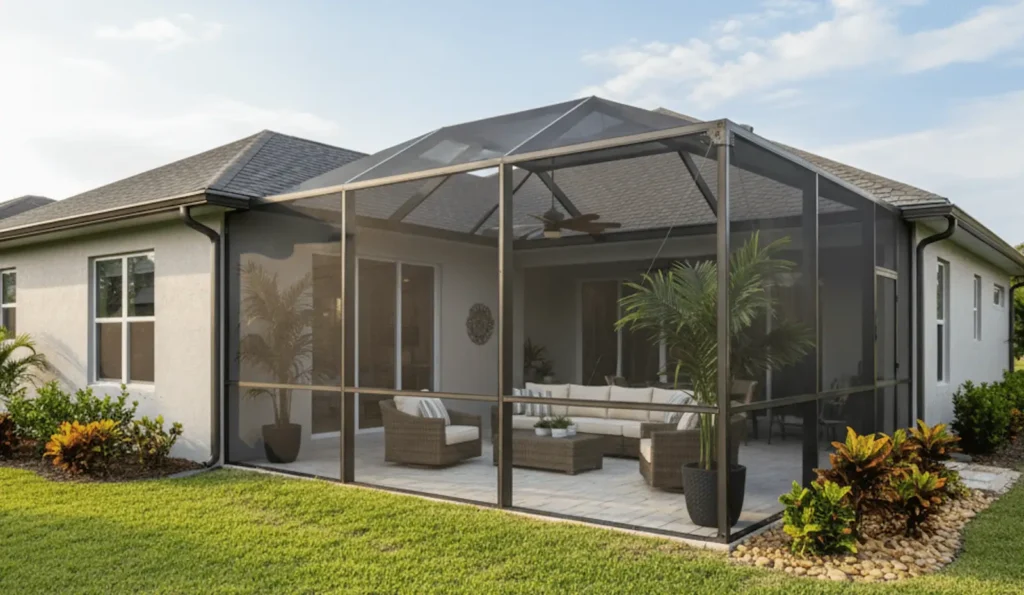
Most Florida lanais already have a roof. What they lack is control over everything that comes in from the sides. Late-afternoon sun slides under the eave, mosquitoes arrive as soon as the light fades, and every breezy day leaves leaves and grit across the floor. So the lanai gets used far less than it should.
A lanai screen installation fixes most of that, but not every screened lanai is equally comfortable. How yours feels depends on choices made before the first frame goes up: the roof system, the mesh on each wall, the roof style and where the door sits. Here is what a screen enclosure actually changes, and which installation decisions decide how well it works.
Table of Contents
What Makes an Open Lanai Uncomfortable
A covered lanai handles overhead sun and rain. The open sides are where the discomfort gets in:
- Insects. Mosquitoes and flies at dawn and dusk, and lizards wandering in from the yard.
- Low-angle sun. Morning and late-day light reaches under the roof and heats the slab and furniture.
- Glare. Light bouncing off pool water, pavers or a pale concrete floor.
- Debris. Leaves, pollen and yard grit blow in and settle on every surface.
- Exposure. Kids and pets can head straight for the yard, and the space feels wide open to it.
Each of these has a specific fix, and most of them are chosen during installation.

7 Ways a Screened Lanai Makes Outdoor Living More Comfortable
1. Mornings and evenings without bugs
Keeping insects and debris out is the main job of a lanai screen enclosure. A well-built one keeps mosquitoes, flies and lizards outside, which is what finally makes dusk usable.
The installation choice that matters: mesh grade. Standard fiberglass mesh handles most insects. If your home backs onto a pond, marsh or the coast, No-See-Um mesh uses an ultra-fine weave to stop the tiny biting insects that standard screen lets through. Fit matters just as much: tight panels with no gaps at the edges or around the door.
2. Less heat under the roof
Shade is the biggest comfort gain in a Florida summer. Insulated roof panels or premium mesh keep a screened lanai cooler and more comfortable through the year.
The installation choice that matters: the roof system and the sun-facing walls. If you are extending the lanai or adding new coverage, insulated roof panels (foam-core sandwich panels) give the strongest shade and heat reduction. On walls that take direct sun, solar screen mesh blocks up to 90% of UV rays and cuts heat buildup.
3. Softer light and less glare
Glare drives people indoors even when the temperature is fine. Solar screen mesh reduces glare and sun exposure, and it slows fading on cushions and outdoor furniture.
The installation choice that matters: mesh by wall. You don’t need one mesh everywhere. Solar screen can go on the side that takes the afternoon sun, with high-visibility mesh facing the pool or garden you want to look at.
4. Fresh air that keeps moving
A screened lanai should still feel like the outdoors. Mesh walls let the breeze through while keeping insects out, so the space doesn’t turn stuffy.
The installation choice that matters: weave and roof shape. High-visibility mesh uses a finer weave for maximum airflow and natural light. On new structures, roof style changes how air moves: a mansard roof creates a high, open interior, and a gable roof adds height at the center.
5. Cleaner floors and furniture
Screens keep out leaves, debris and most yard grit. Furniture stays cleaner between washes, and the floor needs far less sweeping.
The installation choice that matters: materials built for Florida. Rust-resistant aluminum framing and reinforced mesh are designed for Florida’s heat, rain and humidity, so the enclosure keeps doing this job season after season. Our guide to long-lasting screen enclosures covers how to keep it that way.
6. A safer spot for kids and pets
An enclosed lanai gives children and pets a contained outdoor space. You can read or cook without watching the edge of the yard every minute.
The installation choice that matters: tougher mesh where it gets hit. Pet-resistant mesh is a heavy-duty coated polyester made to stand up to scratching and clawing. Aluminum mesh suits doors and lower wall sections where paws, toys and feet make contact most.
7. More hours of the day
Comfort isn’t only about midday. With insulated roof panels, the lanai can take ceiling fans and light fixtures, so it works for early coffee and late dinners alike. A licensed electrician handles the wiring.
The installation choice that matters: planning fixtures before the roof goes on. If you want a fan or lights, choose insulated panels and mention it at the estimate.
Insulated Roof Panels or a Mesh Roof: The Biggest Comfort Decision
If your lanai already sits under the home’s roof, it can be screened in as it is. If you are extending it or building new coverage, the roof system shapes comfort more than any other choice.
| Comfort factor | Insulated roof panels | Mesh (screen) roof |
|---|---|---|
| Shade and heat | Superior shade and heat reduction | Filters UV and glare, depending on the mesh |
| Airflow | Air moves through the screened walls | Highest airflow and natural ventilation |
| Overhead view | Clean, solid finished ceiling | Open-sky view |
| Overhead rain | Solid roof keeps rain off | Mesh lets rain through |
| Ceiling fans and lights | Supported, wired by an electrician | Choose insulated panels if you want them |
| Best for | Maximum comfort and a premium outdoor-room feel | An open, fully ventilated outdoor feel |
Roof style matters too. A hip roof is the strongest option for wind resistance, while a shed roof works well in tight or side-yard spaces.
What a Screen Enclosure Won’t Do
Knowing the limits helps you plan the right build.
- Sideways rain. Mesh walls slow wind-driven rain but don’t stop it. A solid roof keeps overhead rain off, but the edges can still get wet in a storm.
- Air conditioning. Shade and airflow make the lanai feel cooler, but it is still outdoor space. On the hottest afternoons, a ceiling fan does a lot of the work.
- A glassed-in room. If you want something closer to an indoor room, look at Florida room installation instead.
What to Expect From a Lanai Screen Installation
- Free on-site estimate. The space is measured and the options are discussed. Mention which side gets afternoon sun, whether you have pets and when bugs are worst; those answers shape the mesh and roof choices.
- Engineering and permits. Lanai enclosures often need a permit, depending on the structure, and Eclipse handles the engineering and permitting. In a deed-restricted community, check your HOA rules early.
- Installation. Most lanai screen installations take 1–2 days once permits are approved and the USA-made materials are ready. Frames come in white or bronze aluminum.
Frequently Asked Questions
Can you screen in a lanai that already has a roof?
Yes. An existing covered lanai can be screened in, or a new enclosure can be built from scratch. See what it takes to screen in a covered lanai.
Will a screened lanai actually feel cooler?
Yes, through shade and moving air. Insulated roof panels and solar screen mesh make the biggest difference, though a screened lanai is still outdoor space, not a cooled room.
Which mesh makes a lanai most comfortable?
It depends on your main problem: No-See-Um mesh for tiny biting insects, solar screen for sun and glare, high-visibility mesh for views and airflow, and pet-resistant mesh for homes with dogs or cats. Our screen mesh guide goes deeper.
Can I add a ceiling fan or lights to my lanai enclosure?
Yes, with insulated roof panels. The panels support fans and fixtures, and a licensed electrician does the wiring.
How long does lanai screen installation take?
Typically 1–2 days after permits and materials are ready.
Make Your Lanai the Room You Actually Use
A lanai earns its place when you use it every day, not only on the mildest ones. The right lanai screen installation service in Florida turns it into a space that works at 7 a.m. and at 9 p.m. Eclipse Service Hub is a licensed (#SCC131154203) and insured contractor providing screen enclosure services in Florida, with an in-house team across the Tampa Bay area, Sarasota/Bradenton and Southwest Florida. Book a free on-site estimate or call (813) 743-3003 to plan a lanai built around how you want to use it.