
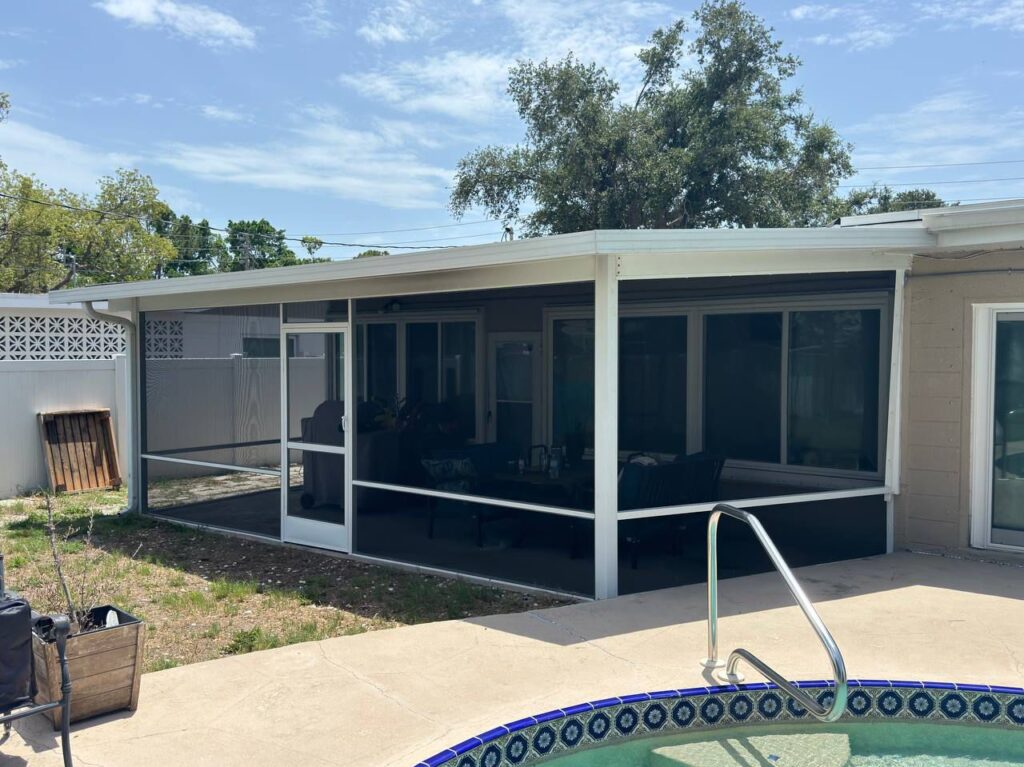
A lot of Tampa homes already have a covered patio an extended roofline, an attached overhang, or a standalone structure built years before screening was ever part of the plan. The question that comes up almost every time: can the existing roof just be screened in, or does the whole thing need to be rebuilt?
The honest answer is that it depends on a handful of specific factors, and it’s worth understanding them before assuming either way.
Table of Contents
What Actually Determines If an Existing Roof Can Be Screened
Structural Support at the Perimeter
Screening requires a frame to attach to along the edges of the roofline posts, beams, or a knee wall that the mesh panels and framing can be secured into. If your existing patio roof was built with open sides and no perimeter support, that framing typically needs to be added before screening is possible. If posts or supports already exist in reasonable condition, that part of the job may already be halfway done.
Roof Material and Condition
Not every roof material is a straightforward match for screen attachment. A solid, well-maintained roof structure whether it’s a traditional shingled overhang or an aluminum patio cover is usually workable. A roof showing rot, sagging, or structural wear is a different story: screening won’t fix an underlying roof problem, and attaching a frame to a compromised structure isn’t a good long-term solution.
Overall Roof Shape and Height
Screening works best with roof shapes that allow mesh panels to run in reasonably straight, continuous sections. Very low clearances, unusual angles, or rooflines with multiple intersecting planes can complicate where framing attaches and how mesh panels are sized and fitted. It’s not necessarily a dealbreaker, but it often means more custom fabrication than a standard rectangular patio roof.
Local Code and Permit Requirements
Even when an existing roof is structurally suitable, adding screening still typically requires a permit, since it changes the structure’s classification and may involve wind-load considerations. This is the same permitting process covered in our guide on pool cage permits in Florida, and it applies whether you’re building new or adding screening to something that already exists.

When Screening the Existing Roof Makes Sense
If the roof is structurally sound, the perimeter can support proper framing, and the shape is straightforward, screening an existing patio roof is often the faster and more practical route. You keep the roof you already have including any aesthetic or architectural details that match your home — and simply add the screening and framing needed to enclose it.
When It Makes More Sense to Build New
A few situations tend to point toward starting fresh rather than retrofitting:
- The existing roof has structural issues that need to be addressed regardless of screening plans
- There’s no usable perimeter support, meaning most of the framing would need to be added anyway
- The roofline doesn’t lend itself to standard screen panel sizing, making a custom retrofit more complex (and sometimes less cost-effective) than a new, purpose-built enclosure
- You want a different roof style entirely if you’re set on a specific look covered in our roof style comparison guide, it may be simpler to build that shape from scratch than force it onto an existing structure
How to Know Which Situation You’re In
The honest answer almost always requires an on-site assessment. A patio that looks straightforward from the ground can have perimeter or structural issues that aren’t obvious without a closer look, and a patio that seems like it needs full replacement sometimes turns out to be a simpler retrofit than expected.
What This Means for Your Project Timeline
If your existing roof turns out to be screen-ready, your project timeline often looks similar to what’s outlined in our guide on what to expect during pool enclosure installation the mesh and framing stages, just without the full roof-building phase. If a new structure is needed instead, the timeline shifts closer to a full installation from the ground up.
Not Sure Which Category Your Patio Falls Into?
Rather than guessing based on how the roof looks from your yard, it’s worth having someone experienced with Tampa patio structures take a real look. Eclipse Service Hub can assess your existing roof and tell you plainly whether screening it in is realistic, or whether a new structure is the better path.
Schedule an on-site assessment or explore our full patio screen enclosure services in Tampa.
Frequently Asked Questions
Do I need a permit to screen in an existing patio roof?
In nearly all cases, yes. Adding screening changes the structure’s classification and often involves wind-load review, so a permit is typically required even when the roof itself already exists.
Can any existing patio roof be screened, or only certain types?
Not every roof qualifies. It depends on whether the perimeter can support proper framing, whether the roof material and structure are in good condition, and whether the shape allows for standard mesh panel sizing.
What if my existing roof has no support posts around the edges?
If there’s no perimeter framing to attach mesh panels to, posts or support beams typically need to be added first. This adds to the project scope but doesn’t necessarily rule out screening the existing roof altogether.
How do I know if my roof needs to be replaced instead of screened?
Signs like sagging, visible rot, or structural wear usually mean the roof needs attention on its own, separate from any screening plans. An on-site assessment is the most reliable way to know for sure.
Does screening an existing roof take less time than building a new enclosure?
Often, yes — if the roof is structurally sound and screen-ready, the project typically skips the full roof-building phase and moves faster to framing and mesh installation.